The free allowance
Vercel’s free Hobby plan allows 200,000 ISR write units over a rolling 30 days. Hobby counts usage in that rolling window, and a feature past its limit waits until 30 days have passed.
Teams that outgrow it move to Pro, at $20 a month.
What a write unit is
Incremental Static Regeneration (ISR) stores each rendered page so visitors get a ready copy. Each time a page’s stored output changes, Vercel counts the bytes written in 8 KB units.
A page’s stored size, HTML plus page data, sets its cost: a 500 KB page is about 63 units per rebuild, and an image-rich page of 1.5 MB about 190.
How an hourly refresh adds up
A timed refresh rebuilds every visited page on each interval, edited or unchanged. As an example, take a 40-page site where ten pages of about 500 KB get visits every hour: 10 pages × 62.5 units × 24 hours × 30 days comes to 450,000 units, 2.25 times the free allowance.
Refresh what changed, on its next visit
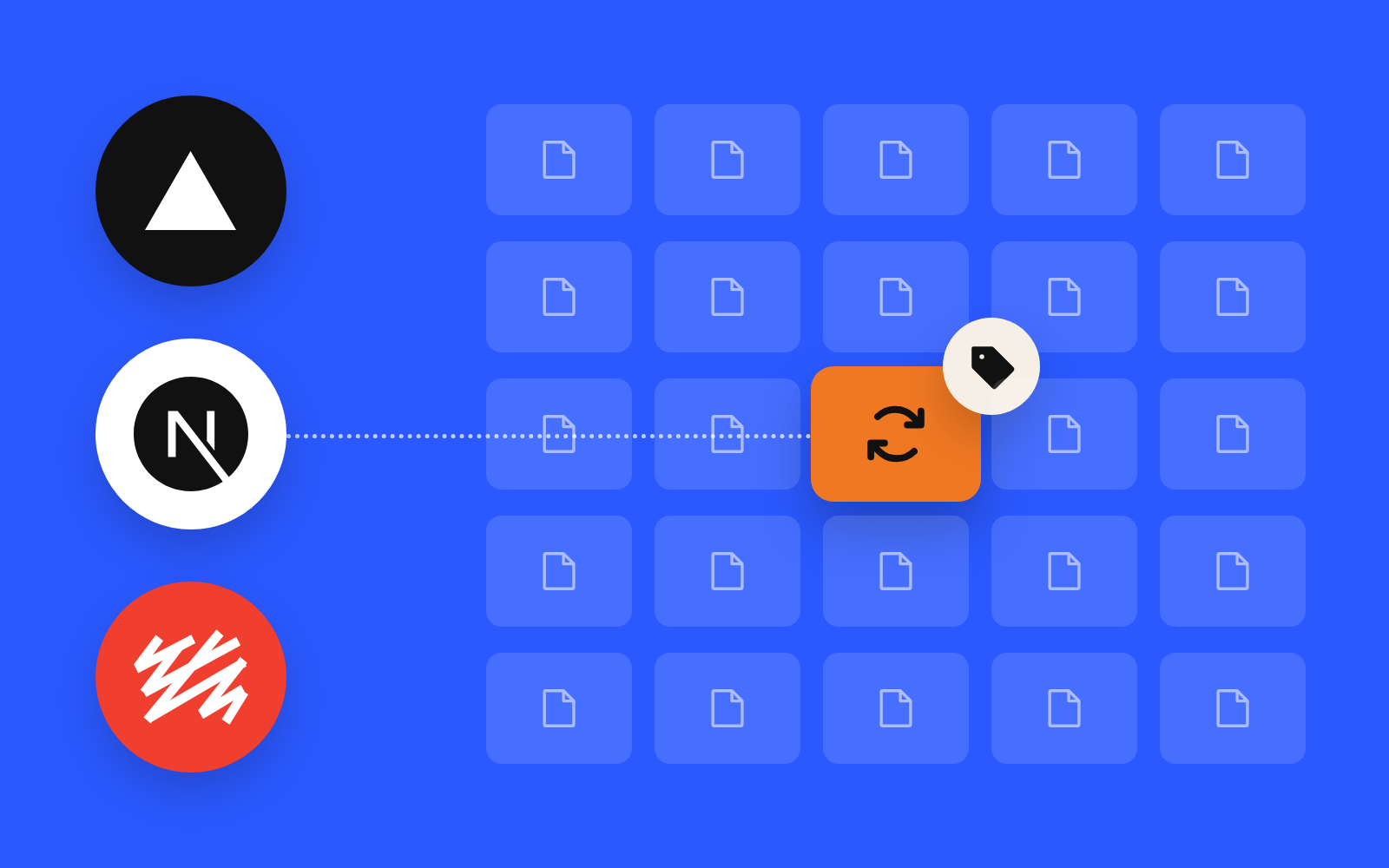
With cache tags, each content read carries a tag for what it reads: a product, a service, the site’s words. Publishing in Sanity calls a webhook, which marks only those tags stale. Each affected page rebuilds once, on its next visit, and visitors keep getting the stored copy meanwhile. In Next.js that is one call:
revalidateTag(tag, 'max')The webhook sends the tags with a projection from Sanity’s Next.js guide, one tag for the document type and one for the document:
{ "tags": [_type, _type + ":" + slug.current] }Next.js describes tags as “ideal for content where a slight delay in updates is acceptable, such as blog posts, product catalogs”, where “pages using the tag revalidate as they are visited rather than all at once”. Sanity’s guide recommends tag-based revalidation for blog posts and products with frequent edits.
What each publish costs
| Change | Pages rebuilt | Write units in the example |
|---|---|---|
| An hour with zero edits | Zero | 0, from 625 with the hourly refresh |
| A product edit | Its product page, the shop, the sitemap | About 190 |
| Site-wide words or a deploy | Every page | About 2,500 |
Page weight, the second lever
Every write shrinks with the page it stores, and lighter pages load faster on phones. Trimming page data pays twice.
Prices stay live
A checkout that reads prices live charges the current price, even when the page itself is a minute old.
Publishing in batches
Sanity’s Content Releases group many changes into one publish, on certain Enterprise plans. On the free plan, drafts work as the commit and Publish as the push: edits gather in a draft and go out together. Tag-based refresh batches by itself too: ten publishes before the next visit rebuild each affected page once.
Websites & AppsSites, stores and web apps on Shopify, Framer, Webflow or custom code, integrations with CMS, CRM and more, servers, and security.Sources
- Published
- Author
- Booban Net.
- Category
- Websites & Apps
- Service
- Servers & cloud